This post may contain affiliate links. If you purchase through our links we may earn a small commission at no extra cost to you. Learn more.
Building your own furniture is one of the most satisfying things you can do with woodworking. You get exactly what you want, built to the dimensions your space needs, for a fraction of what it costs at a furniture store — and without the particleboard, hidden staples, or cam-lock fittings you’d never trust to last a decade. This guide covers four of the most practical furniture builds every woodworker should know: a farmhouse dining table, a queen bed frame, a 5-shelf bookcase, and a coffee table in two variations.
Why Build Your Own Furniture?
The short answer: you get better quality for dramatically less money. A solid wood dining table from a furniture store costs $800–$2,000. Built from pine or poplar at a hardware store, the same table costs $140–$200 in materials. Here’s how the numbers compare across common projects:
| Project | Store-bought cost | DIY materials cost | You save | Build time |
|---|---|---|---|---|
| Farmhouse dining table (72″) | $800–$2,000 | $140–$200 | $650–$1,800 | 1 weekend |
| Queen bed frame | $300–$800 | $80–$120 | $220–$680 | 1 day |
| 5-shelf bookcase (36″W × 72″H) | $150–$400 | $90–$140 | $60–$260 | Half a day |
| Coffee table (simple) | $150–$500 | $45–$75 | $100–$425 | 3–4 hours |
And that’s before accounting for the fact that you can build to the exact dimensions your room needs, choose the exact wood species and finish, and replace a broken component years later without buying a whole new piece.
Watch a Complete Farmhouse Table Build
Before cutting anything, watch this full farmhouse table build from start to finish. It covers pocket hole setup, glue-up technique, figure-8 fastener installation, and finishing — every major technique you’ll use across all the builds on this page.
The Farmhouse Dining Table
The farmhouse table is the project that hooks more people on woodworking than anything else. It looks like something you’d pay $1,200 for, and it’s built from construction lumber and pocket screws. Full step-by-step instructions are in our complete farmhouse table guide — here’s the cut list and approach summary to plan your build.
Cut List — 72″ Farmhouse Table (seats 6)
| Part | Qty | Nominal size | Actual size | Cut length |
|---|---|---|---|---|
| Tabletop boards | 7 | 2×6 | 1½” × 5½” | 72″ |
| Legs | 4 | 4×4 | 3½” × 3½” | 28½” |
| Long aprons | 2 | 1×4 | ¾” × 3½” | 65″ |
| Short aprons | 2 | 1×4 | ¾” × 3½” | 29″ |
Hardware: Kreg pocket hole screws (2½” coarse for aprons, 1¼” fine for tabletop), 8× figure-8 tabletop fasteners, Titebond II wood glue, sandpaper 80–220 grit, stain, polyurethane.
Build approach: Glue and pocket-screw the tabletop boards edge-to-edge into a slab. Build the leg-and-apron base with pocket holes. Attach the tabletop to the base with figure-8 fasteners — never glue the top solid to the base (see finishing section below for why). Sand through all grits, apply pre-stain conditioner on pine, then stain and polyurethane.
Estimated cost: $140–$200. Build time: One weekend (plus finish drying time).
Queen Bed Frame Plans
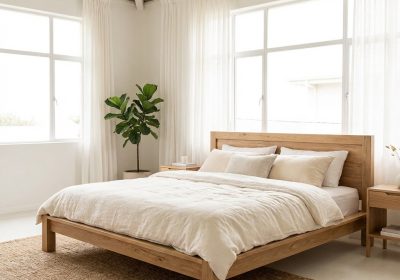
A DIY queen bed frame is one of the highest-value woodworking projects you can build — the store price is $300–$800 for something solid, and you can build a better version for $80–$120. This design uses 2×8 lumber for the outer frame (it needs to handle real weight), 4×4 legs, and 1×4 slats spaced across the centre beam.
Cut List — Queen Bed Frame (60″ × 80″ mattress)
| Part | Qty | Nominal size | Actual size | Cut length |
|---|---|---|---|---|
| Headboard rail | 1 | 2×8 | 1½” × 7¼” | 66″ |
| Footboard rail | 1 | 2×8 | 1½” × 7¼” | 66″ |
| Side rails | 2 | 2×8 | 1½” × 7¼” | 82″ |
| Centre beam | 1 | 2×8 | 1½” × 7¼” | 57″ |
| Legs | 4 | 4×4 | 3½” × 3½” | 14″ |
| Slats | 13 | 1×4 | ¾” × 3½” | 60″ |
| Centre leg (floor support) | 1 | 4×4 | 3½” × 3½” | 14″ |
Hardware: 4× ⅜” × 3½” carriage bolts with nuts and washers (frame corners), metal bed frame rail connectors (the bracket hardware that locks side rails to head and footboard — available at any hardware store for ~$12 a set), 2½” construction screws for slat attachment, wood glue.
Key notes: Cut legs at 14″ — this puts the top of the mattress at about 25″ off the floor with a standard platform mattress, which is a comfortable sit-and-stand height for most adults. Bolt the frame corners rather than screwing them: the carriage bolts handle the shear forces of people climbing in and out without loosening over time. Add the centre support leg to the floor at the midpoint of the centre beam — queen and king frames will flex and squeak without it. Space slats approximately 6″ apart (13 slats at 60″ width, with gaps between them). Most mattress manufacturers specify no gap larger than 3″–4″ — check your mattress warranty if in doubt.
Estimated cost: $80–$120. Build time: One day (the frame assembles in 4–5 hours; legs are a separate glue-up).
5-Shelf Bookcase Plans
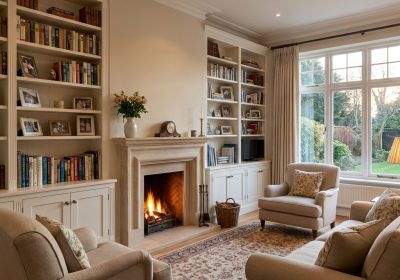
A bookcase teaches you to work perfectly square — if the carcass is even slightly racked, every shelf will look crooked and the doors (if you add them) will never fit. This design builds a 36″ wide × 72″ tall × 12″ deep 5-shelf unit from ¾” plywood with a 1×2 pine face frame that hides the plywood edges and gives it a furniture-quality look.
Cut List — 36″W × 72″H × 12″D Bookcase
| Part | Qty | Material | Width | Length |
|---|---|---|---|---|
| Side panels | 2 | ¾” plywood | 12″ | 72″ |
| Top panel | 1 | ¾” plywood | 12″ | 34½” |
| Bottom panel | 1 | ¾” plywood | 12″ | 34½” |
| Interior shelves | 3 | ¾” plywood | 12″ | 34½” |
| Back panel | 1 | ½” plywood | 36″ | 72″ |
| Face frame stiles (vertical) | 2 | 1×2 pine | 1½” | 72″ |
| Face frame rails (horizontal) | 6 | 1×2 pine | 1½” | 33″ |
Note on dimensions: The shelves are 34½” long (not 36″) because the two ¾” side panels each take up ¾” — 36″ − (¾” + ¾”) = 34½”. The top, bottom, and all interior shelves use the same dimension, which means you can gang-cut them all at once.
Hardware: 1¼” pocket screws (carcass assembly), 1½” brad nails or finish nails (face frame attachment), wood glue, shelf pin hardware (drill ⅜” shelf pin holes if you want adjustable shelves rather than fixed).
Key tip: Always use ¾” plywood for shelves over 36″ wide — do not use solid pine boards. Solid pine boards over 36″ will sag under book weight over 12–18 months, especially with heavy hardcover books on the upper shelves. Plywood doesn’t have this problem because its cross-laminated construction resists flex. The back panel is what keeps the carcass square: nail it on last, after checking that both diagonals are equal.
Estimated cost: $90–$140. Build time: Half a day (3–4 hours).
Coffee Table Plans — Two Variations
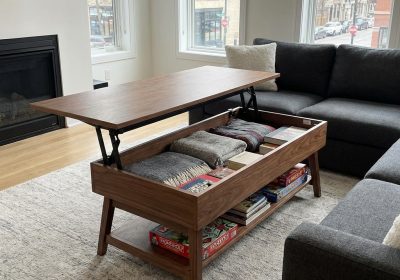
Once you’ve built one coffee table you’ll start seeing variations everywhere. Here are two builds at different levels — the first is a classic solid-wood table for beginners, the second is a modern hairpin-leg version that takes about half the time.
Option A: Classic 4×4 Leg Coffee Table
| Part | Qty | Nominal size | Actual size | Cut length |
|---|---|---|---|---|
| Top boards | 2 | 2×10 | 1½” × 9¼” | 48″ |
| Legs | 4 | 4×4 | 3½” × 3½” | 17″ |
| Long aprons | 2 | 2×4 | 1½” × 3½” | 41″ |
| Short aprons | 2 | 2×4 | 1½” × 3½” | 15″ |
This puts the tabletop at 18½” off the floor — the standard height for a coffee table used with a sofa. Assemble with pocket holes throughout. Top width will be approximately 18½” (two 9¼” boards side by side); top length is 48″. Finish with stain and polyurethane to match your existing furniture.
Estimated cost: $45–$65. Build time: 3–4 hours.
Option B: Hairpin Leg Coffee Table (Modern Look, Minimal Tools)
This version replaces the built wood base with a set of metal hairpin legs — three-rod, 16″ height — available in sets of four for $25–$35 online. The top is a glued-up pine slab: rip three or four 1×6 or 1×8 boards to consistent width, glue them edge-to-edge with Titebond II, clamp overnight, sand flat, and finish. The hairpin legs screw directly to the underside with the included hardware.
Cut list for the top: 3× 1×8 at 48″ long (actual width per board: 7¼”), glued to make an approximately 21¾” × 48″ top. Trim the width after glue-up if you want a clean even dimension.
Estimated cost: $50–$75 (hairpin legs $30, lumber $20–$35, finish $10). Build time: 3 hours (plus overnight glue-up cure).
The One Rule That Protects Every Solid Wood Tabletop
Wood is not a static material. It absorbs and releases moisture with the seasons, expanding across its width in humid months and contracting in dry ones. A solid pine tabletop 18″ wide will move approximately ¼” per foot of width across the seasons — that’s about ⅜” of movement total side-to-side. That movement is invisible when the table is designed correctly. It causes cracking and racking when it isn’t.
The rule: never glue a solid wood tabletop directly to its base. The base is constrained. The top needs to move. If you glue them together, the top will either crack or pull the base apart — usually within 12 months in climates with distinct seasons.
Instead, use figure-8 fasteners or Z-clips. Figure-8 fasteners are small metal discs that screw into the apron on one side and the tabletop underside on the other. They rotate slightly as the top moves, allowing seasonal expansion and contraction without stress. They cost about $8 for a pack of eight and take five minutes to install. Use them on every solid wood tabletop, every time.
Get 16,000 Furniture Plans — With Full Cut Lists
Every furniture project above has dozens of variations — different sizes, wood species, joinery methods, and finish styles. When you’re ready to build beyond this guide, Ted’s Woodworking includes over 16,000 professionally drawn plans across every category — dining tables, bed frames, bookshelves, cabinets, chairs, outdoor furniture, and hundreds more — each with a complete cut list, materials list, and step-by-step instructions.