The bookshelf is one of the most versatile woodworking projects you can build. At the easy end, it’s four sides and a shelf — a project that takes two hours and costs AU$30. At the advanced end, it’s a floor-to-ceiling library wall with a rolling ladder, dovetailed joints, and hand-rubbed finish — a project that takes weeks and produces something that will outlast you. Between those extremes is a complete spectrum of designs, each teaching different skills and serving different rooms. This guide walks through 10 bookshelf designs in order of difficulty, so you can pick your entry point and work your way up.
10 Bookshelf Designs: Difficulty and Cost at a Glance
| Design | Difficulty | Primary Materials | Approx Cost (AU$) | Best For |
|---|---|---|---|---|
| Simple Box Shelf | Beginner | MDF or plywood | $25–$40 | First build, small spaces |
| Ladder Shelf | Beginner | Pine DAR | $40–$70 | Living room, bedroom |
| Floating Shelves | Beginner–Intermediate | MDF + plywood cleat | $30–$60 per shelf | Hallways, offices, living rooms |
| Cube Shelves | Beginner–Intermediate | MDF or birch ply | $60–$120 | Kids’ rooms, modular storage |
| Hairpin Leg Shelf | Beginner | Solid timber + steel legs | $80–$150 | Industrial/Scandi interiors |
| Mid-Century Modern | Intermediate | Walnut, oak or teak veneer ply | $150–$300 | Lounge room statement piece |
| Built-In Bookshelf | Intermediate | MDF + pine face frame | $150–$250 | Full wall, living or study |
| Barrister Bookcase | Intermediate–Advanced | Hardwood + glass | $300–$600 | Home office, study, legal/academic |
| Industrial Pipe Shelf | Beginner | Reclaimed timber + steel pipe | $80–$180 | Industrial/loft interiors |
| Library Ladder Shelf | Advanced | Hardwood + custom rail hardware | $500–$1,200+ | Full library walls, high ceilings |
1. Simple Box Shelf — Beginner
The simple box shelf is four panels of 18 mm MDF or plywood assembled into a rectangle, with one or two fixed shelves inside. No face frame, no moulding, no legs — just a clean box shape. The key skill is cutting accurately and assembling square. Screw and glue the corners, fill the screw heads, sand, and paint in any colour you like. Wall-mount it horizontally as a floating cubby, or stand it vertically as a narrow bookcase. This is the project to build if you’ve never used a drill or circular saw before — the tolerances are forgiving and the result is immediately useful.
2. Ladder Shelf — Beginner
Two long rails and five horizontal shelves. The design leans against the wall at a slight angle, eliminating the need for complex wall fixings. The classic proportions have the shelf getting slightly narrower from bottom to top, mimicking a real ladder. Build it from 42 × 19 mm and 140 × 19 mm pine DAR. Finish in paint for a Scandi look, or stain and oil for a natural timber aesthetic. See the full build guide for this design in Post 100. Key skills: accurate marking out, basic screwed joinery, checking for square.
3. Floating Shelves — Beginner to Intermediate
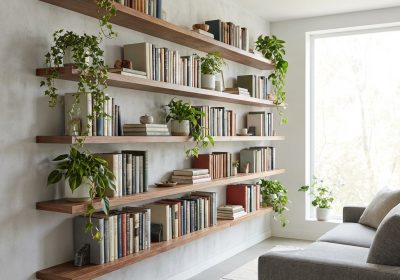
Floating shelves use a hidden wall cleat to support a hollow shelf box, creating the illusion of shelves growing from the wall. More installation skill than build skill — the critical steps are locating wall studs and setting the cleat perfectly level. The shelves themselves are simple boxes of 18 mm MDF with a hardwood edge banding front. A set of three at staggered heights transforms a blank wall into a styled display surface. See the full guide in Post 101. Key skills: stud finding, French cleat cutting, level installation.
4. Cube Shelves — Beginner to Intermediate
Cube shelves are modular box units — usually 300 × 300 mm or 400 × 400 mm interior — that can be stacked, combined, or arrayed in any configuration. Build them from 18 mm birch ply or MDF and paint or leave natural. Add a back panel to each cube for a clean look, or leave it open to use the wall as the backdrop. Cube shelves teach accurate dimensioning — all six panels of each cube need to be exactly square for the cubes to stack evenly. Add doors, baskets, or drawer inserts to selected cubes for a mix of open and closed storage. Key skill: precision cutting.
5. Hairpin Leg Shelf — Beginner
A slab of solid timber — pine, spotted gum, blackbutt, or similar — with two or three hairpin legs bolted to the underside. Used as a low shelf or sideboard rather than a tall bookcase. The appeal is the contrast between warm natural timber and thin black steel. Choose a slab at least 300 mm wide for the shelf to be functional. Sand to 220, apply danish oil or hardwax oil, screw on the legs, and you’re done. No joinery, no complex steps. Key skill: surface preparation and finishing.
6. Mid-Century Modern Bookshelf — Intermediate
The mid-century modern style is characterised by tapered legs, clean horizontal lines, and warm timber tones. Build the carcass from walnut veneer plywood or oak veneer ply (available from specialty timber merchants and some Bunnings stores in capital cities). The legs are the distinctive element — cut tapered legs from solid timber on a band saw or with a tapering jig on a table saw, or buy pre-cut tapered timber legs online. The joinery is pocket screws or biscuits. The finish is danish oil or hardwax oil — polyurethane looks too plasticky for this style. Key skills: veneer plywood handling, tapered leg cutting, careful edge finishing.
7. Built-In Bookshelf — Intermediate
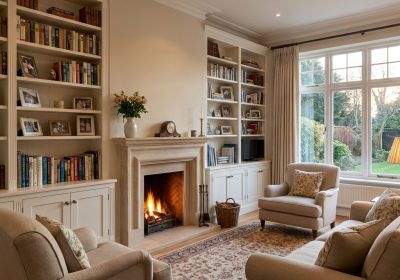
The most impactful bookshelf you can build, because it transforms the room rather than sitting in it. A built-in is a carcass of MDF panels fixed to the wall, with a timber face frame, crown moulding at the ceiling, and paint finish that matches the walls. It looks like architectural millwork but it’s built from Bunnings materials. The key skills are scribing panels to fit uneven walls, cutting crown moulding angles, and painting MDF to a smooth finish. See the full guide in Post 102. Cost AU$150–$250 for a 2.4 m × 1.2 m unit.
8. Barrister Bookcase — Intermediate to Advanced
The barrister bookcase is a stackable cabinet system with individual glazed-door sections. Each section is a separate box with a glass-pane door that pivots up and slides back horizontally into the section when open. The stacking base, middle sections, and crown cap are all separate pieces. The appeal is the authentic early-twentieth-century aesthetic and the dust protection for books. Build from solid oak, mahogany, or a good hardwood DAR timber. The glazed doors require routing a rebate for the glass — that step requires a router and some practice. A four-section barrister bookcase is a project that takes a full weekend plus finishing days. Key skills: router rebating, fitting glass, precision joinery.
9. Industrial Pipe Shelf — Beginner
Galvanised or black steel pipe flanges mount to the wall and hold timber shelf boards — reclaimed, stained, or left with a raw mill finish. The pipe fittings are plumbing fittings available at Bunnings (floor flanges, pipe sections, elbows). The timber sits in the pipe brackets without fastening — the weight holds it. Assembly is mostly plumbing work rather than woodworking, but surface finishing the timber shelves is a satisfying and accessible step. Key skills: stud location, pipe assembly, timber finishing.
10. Library Ladder Shelf — Advanced
A floor-to-ceiling bookshelf wall with a rolling ladder on a rail. The rail mounts to the face frame of the built-in at ceiling height. The ladder rolls along the rail on specialised hardware (available from Bunnings or online hardware suppliers). The built-in itself is constructed the same way as the intermediate built-in (see Design 7), but taller, wider, and engineered to carry the load of the ladder and a person climbing it. The ladder itself is built from hardwood with a slight backward taper so it rests against the shelving rather than pulling away. Key skills: all intermediate skills plus structural load calculation, ladder construction, and rail installation.
Which Design Should You Start With?
If you’ve never built furniture before, start with the simple box shelf or the ladder shelf. Both teach the core skills — accurate cutting, square assembly, and finishing — without complex joinery or wall installations. Once you’ve done either of those, you have the foundation for every other design on this list. Work your way up through the table in order and you’ll have built every major bookshelf type within a year of consistent weekend woodworking.
For detailed, measured plans for any of the designs in this list, Ted’s Woodworking has over 16,000 woodworking plans including every bookshelf style listed here, all with complete cut lists and step-by-step build instructions.