If you’re about to buy your first piece of timber and you want a simple, honest answer — it’s pine. Not because it’s exotic or particularly beautiful, but because it lets you learn without fighting the material. It cuts easily, glues reliably, sands fast, and costs less than a cup of coffee per lineal metre at Bunnings. Here’s everything you need to know about why pine wins for beginners, and where its limitations lie.
Why Pine Is the Easiest Wood to Work With
Pine is a softwood, which means it sits lower on the Janka hardness scale than hardwoods like oak or jarrah. For beginners, that’s an advantage: your saws cut through it with less resistance, your sandpaper removes material quickly, and driving a screw doesn’t require pre-drilling as often (though it’s still good practice).
Radiata pine — the most common variety sold in Australian hardware stores — has a consistent grain structure and relatively few dramatic figure variations. This makes it predictable. When you’re learning how grain affects cutting direction or how a finish soaks in, predictability is your friend.
Practical advantages of pine for beginners:
- Available at every Bunnings and Mitre 10 — no specialist sourcing required
- Cheap enough to make mistakes without regret
- Takes wood glue extremely well
- Sands smooth in minutes with a random orbital sander
- Dimensionally consistent (DAR dressed boards are stable and square)
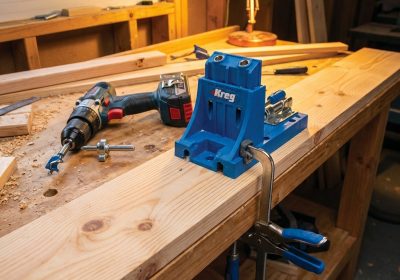
- Holds pocket hole screws reliably when used with the right screw gauge
Pine vs Poplar vs MDF: Honest Comparison
| Characteristic | Pine | Poplar | MDF |
|---|---|---|---|
| Janka Hardness | ~1,630 N (soft) | ~2,800 N (medium) | N/A (not solid wood) |
| Ease of cutting | Excellent | Very good | Excellent (blunts blades faster) |
| Ease of sanding | Excellent | Good | Excellent (but creates fine dust) |
| Stain/finish result | Moderate — blotches without prep | Poor natural look, excellent when painted | Paint only — no natural look possible |
| Screw holding | Good | Very good | Poor at edges, fair in face |
| Water resistance | Moderate (seal it) | Moderate | Poor — swells and crumbles |
| Cost (approx.) | $4–$8/lm | $6–$10/lm | $25–$55/sheet |
| Available at Bunnings? | Yes — always | Rarely | Yes — always |
| Best for beginners? | Yes — first choice | Second choice (if painted) | Good for flat, painted work only |
The Staining Problem With Pine (And How to Fix It)
Pine’s biggest weakness is blotching under oil-based stains. The wood has alternating bands of early wood (soft, light-coloured, absorbs stain heavily) and late wood (denser, darker, absorbs stain lightly). When you apply stain directly, the result is uneven — splotchy and patchy in a way that looks like a mistake, not a feature.
There are three ways to handle this:
- Pre-stain wood conditioner: Apply this before the stain and let it dry for 15–30 minutes. It partially seals the softer early wood zones so absorption is more even. Use Feast Watson or Cabot’s pre-stain conditioner.
- Gel stain: Gel stains are thicker and sit on top of the wood surface rather than soaking in deep. They produce a more controlled, even colour on pine. Minwax Gel Stain is the most widely available option.
- Paint it: For most beginner projects, a quality water-based paint (Dulux Aquanamel or Taubmans Endure) over lightly sanded pine produces a beautiful result with zero blotching issues. Many professional furniture pieces are simply painted pine.
Knots in Pine: Feature or Problem?
Standard construction pine from Bunnings contains knots — circular darker zones where branches once grew. For structural or painted projects, knots don’t matter structurally. For stained or clear-finished projects, knots can seep resin over time and cause bleed-through under paint and varnish.
Fix knotty pine for finishing by sealing knots with shellac-based primer (Zinsser BIN is the standard) before painting. This seals the resin in and prevents bleed-through indefinitely. If you want knot-free pine from the start, ask for “clear pine” or “furniture pine” at a specialist timber yard — it costs more but produces a much cleaner result under clear finishes.
Your First Pine Project: A Simple Floating Shelf
The best first project for a beginner with pine is a set of floating shelves. Here’s why it works as a learning exercise:
- Requires only cross-cuts (straight cuts across the board width) — the simplest saw operation
- Teaches you how to sand properly through progressive grits (80 → 120 → 180)
- Introduces you to finishing (paint, stain, or clear coat)
- Produces something useful you’ll actually use every day
- Total material cost under $30 for a set of three shelves
Start with 140×19mm DAR pine, cut to your wall lengths, sand through to 180 grit, prime with Zinsser BIN if knotty, then apply two coats of Dulux Aquanamel in your wall colour. Install with keyhole brackets or a French cleat system. You’ll have shelves that look like they came from a furniture store.
When to Move Beyond Pine
Pine is a starting point, not a limitation. Once you’ve built 5–10 projects and feel comfortable with your tools, moving to hardwoods like Tasmanian oak, American white oak, or spotted gum unlocks a new level of quality. These woods take finishes more beautifully, resist denting better, and produce furniture that genuinely improves with age. But they also cost more and require sharper tools and better technique. Pine teaches you those fundamentals at low cost before you graduate.
Get Serious About What You Build
Pine is the wood — now you need projects worth building. Ted’s Woodworking has over 16,000 step-by-step plans including dozens of beginner pine projects with full cut lists, material specifications, and assembly diagrams. It’s the most practical library of woodworking plans available for beginners who are ready to actually build things.