So you want to start woodworking — but you’re not sure where to begin. You don’t have a shop full of tools. You’re not sure what wood to buy. And every YouTube video seems to assume you already know what a mortise is.
This guide is for you. By the end, you’ll know exactly what tools to buy (on a budget), which projects to start with, and how to read a woodworking plan so you can build anything you want.
What Tools Do You Actually Need to Start?
The internet will tell you that you need a $2,000 table saw before you can do anything useful. That’s wrong. Here’s what you actually need to start building real projects:
The Non-Negotiables (Under $150 Total)
- Cordless drill/driver — Do everything else before buying power tools. A basic 18V drill from DEWALT, Ryobi, or Makita does 90% of the work. (~$60)
- Tape measure — 25ft, with a lock. (~$10)
- Speed square — Marks 90° and 45° cuts. More useful than it looks. (~$8)
- Clamps (4–6) — You can never have too many clamps. Start with a set of 6-inch F-clamps or bar clamps. (~$30)
- Hand saw or jigsaw — A jigsaw cuts curves and straight lines and is forgiving for beginners. (~$40)
- Sandpaper assortment — 80, 120, 180, and 220 grit. (~$10)
Your First Power Tool Upgrade: The Circular Saw
Once you’ve built a couple of projects with hand tools, a circular saw opens up everything. You can rip plywood, cut boards to length, and tackle furniture and shed projects. A budget circular saw runs $50–$80 and is the single best upgrade a beginner can make.
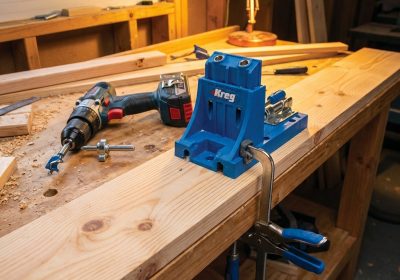
The Game-Changer: A Kreg Pocket Hole Jig
A pocket hole jig lets you join two pieces of wood with angled screws — no complex joinery, no need for a router, no experience required. The Kreg R3 costs around $25 and makes furniture-quality joints that are incredibly strong. If you buy one “extra” tool in your first year, make it this one.
The 5 Best First Projects (With Free Plans)
Starting with the right project matters more than having the right tools. These five builds are forgiving, useful, and will teach you the core skills you need for everything else.
1. A Simple Workbench or Sawhorse (Difficulty: 2/5)
Before you build anything else, build something to work on. A basic sawhorse made from 2×4s requires just a saw, a drill, and a handful of screws. It takes about two hours and teaches you how to measure, cut, and assemble. You’ll use it for every project after.
2. A Wooden Toolbox (Difficulty: 2/5)
A classic first project for good reason. You’ll learn to cut boards to the same length, drill at consistent angles, and deal with the reality that wood doesn’t always behave. It doesn’t matter if yours looks a little rough — it’s a toolbox, not fine furniture.
3. A Garden Planter Box (Difficulty: 2/5)
Great for outdoor use and very forgiving of imprecise cuts. Cedar or pressure-treated pine is affordable and weathers well. You’ll practice measuring for equal lengths and assembling square corners — skills that carry into every furniture project.
4. A Coffee Table (Difficulty: 3/5)
Your first “real” furniture piece. A simple coffee table with 4×4 legs and 2×6 top boards can be built for under $40 in materials. Use a Kreg jig for the joints and you’ll end up with something you’re genuinely proud of.
5. A Small Storage Shed (Difficulty: 4/5)
Once you’ve done a couple of smaller projects, a small 8×6 shed is the natural progression. You’ll learn wall framing, roofing basics, and how to work with larger materials. Full step-by-step shed plans are available if you want the exact process laid out for you.
How to Read a Woodworking Plan
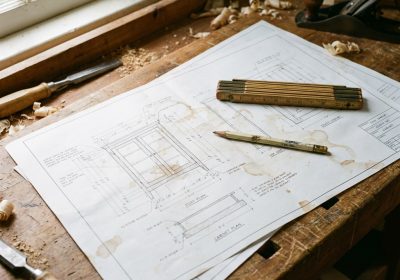
Woodworking plans look intimidating until you understand the four things every plan includes:
- Cut list — Every piece of wood you need, with exact dimensions (length × width × thickness). This is your shopping list.
- Materials list — The screws, hardware, glue, and finish you’ll need.
- Assembly diagrams — Exploded-view drawings showing how parts fit together. Read these before you start cutting anything.
- Step-by-step instructions — Written in the order you should build. Don’t skip steps, even if they seem obvious.
The most common beginner mistake is starting to cut before reading the whole plan. Spend 10 minutes reading it end-to-end first. You’ll catch things that would otherwise cost you a trip back to the hardware store.
Choosing the Right Wood
The hardware store has dozens of wood species. Here’s what beginners should actually use:
Pine (Recommended for Beginners)
Cheap, widely available, and easy to cut. Looks great stained or painted. The downside: it dents and scratches more easily than hardwoods. Use it for furniture that won’t take heavy daily use, and for learning on.
Plywood (The Secret Weapon)
3/4″ plywood is incredibly strong, doesn’t warp like solid wood, and is perfect for shelving, cabinet carcasses, and workbenches. It’s not glamorous, but it’s cheap and reliable. Buy cabinet-grade for projects you’ll see; construction-grade for things you won’t.
Cedar and Pressure-Treated Pine (Outdoor Projects)
For anything that lives outside — planters, shed walls, decking — use cedar or pressure-treated pine. Both resist moisture and rot. Cedar smells great and looks better; PT pine costs less.
5 Mistakes Every Beginner Makes (And How to Avoid Them)
- Measuring twice but only cutting once — Mark with a pencil, then double-check before cutting. A $3 offcut teaches this lesson faster than anything.
- Skipping sanding grits — Going from 80 to 220 directly leaves scratches from the 80 visible under your finish. Work through 120, then 180.
- Not checking for square — A speed square is $8. Use it after every joint. Everything downstream of an out-of-square corner compounds.
- Overbuying tools before you know what you need — Build three projects before buying any tool you weren’t using on the previous one.
- Choosing the wrong first project — A dining table with mortise-and-tenon joints is not a first project. Build something small and useful first.
Where to Get Plans
Free plans are available from Ana White, Instructables, and the Family Handyman — all excellent for straightforward projects. When you’re ready to move beyond free resources, Ted’s Woodworking gives you access to over 16,000 professionally drawn plans with full cut lists, material lists, and step-by-step instructions across every project category. It’s the resource we recommend when you’re ready to build seriously.
Subscribe below and we’ll send you a free collection of beginner plans to get started today.