This post may contain affiliate links. If you purchase through our links we may earn a small commission at no extra cost to you. Learn more.
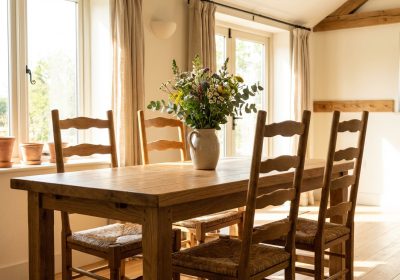
A farmhouse dining table is one of the best first furniture builds you can do. It uses inexpensive construction lumber, basic joinery (pocket holes), and standard tools — yet the finished result looks like something you’d pay $800+ for at a furniture store. This guide gives you everything you need: real dimensions, a complete cut list, step-by-step instructions, and finish options.
Finished dimensions: 72″ long × 36″ wide × 30″ tall (seats 6 comfortably; see sizing notes below for 8-person)
Skill level: Beginner — if you can cut straight lines and drive screws, you can build this
Build time: 6–8 hours over a weekend (plus drying time)
Estimated cost: $140–$200 in materials
Watch the Build First
Before cutting a single board, watch this complete farmhouse table build. It covers every step including pocket hole setup, glue-up, and finishing.
Lumber & Materials
Wood (using dimensional pine from a hardware store)
| Piece | Qty | Nominal size | Actual size | Cut length |
|---|---|---|---|---|
| Tabletop boards | 7 | 2×6 | 1½” × 5½” | 72″ |
| Long aprons | 2 | 1×4 | ¾” × 3½” | 65″ |
| Short aprons | 2 | 1×4 | ¾” × 3½” | 29″ |
| Legs | 4 | 4×4 | 3½” × 3½” | 28½” |
Important — lumber selection: At the hardware store, hand-pick every board. Look down the length of each board to check for bow or twist. Reject anything that isn’t straight. For tabletop boards especially, also check for large loose knots. Budget an extra 10–15% for culls.
Hardware & Consumables
- Pocket hole screws: 2½” coarse thread (for apron-to-leg joints) — 1 box
- Pocket hole screws: 1¼” fine thread (for tabletop board glue-up) — 1 box
- Figure-8 tabletop fasteners: 8 pieces (allows wood movement, prevents cracking)
- Wood glue: 1 medium bottle (Titebond II or III)
- Sandpaper: 80, 120, 150, 220 grit
- Wood stain (optional): Minwax Early American or Dark Walnut are popular farmhouse tones
- Polyurethane (water-based for light stains; oil-based for deeper tones): 1 quart
- Foam brushes or lint-free rags for finish application
Tools Required
Essential
- Kreg pocket hole jig (R3, 320, or 720 — any model works)
- Drill/driver with #2 square bit and step drill for pocket holes
- Circular saw or miter saw (for crosscuts) — a miter saw makes cleaner cuts but isn’t required
- Tape measure
- Speed square or combination square
- At least 4 bar clamps (6 is better for the glue-up)
- Random orbital sander
Helpful but optional
- Table saw (for ripping boards to exact width — not required if you’re satisfied with nominal widths)
- Router with roundover bit (for softening tabletop edges)
- Pocket hole clamp (keeps joints tight while drilling)
Step-by-Step Build Instructions
Step 1 — Cut all lumber to length
Cut everything to the lengths in the cut list before assembly. Mark each piece with tape and a marker so you don’t mix them up. Double-check: the legs are 28½” (not 30″) because the tabletop adds the remaining 1½”.
Sizing note for an 8-person table: Extend the tabletop boards and long aprons to 96″. Long aprons become 89″. Everything else stays the same.
Step 2 — Set up pocket holes on tabletop boards
Set your Kreg jig to the 1½” material thickness setting. Drill two pocket holes every 16″ along one long edge of each tabletop board, plus two holes at each end. You’ll use these to pull the boards tight together edge-to-edge.
Step 3 — Glue up the tabletop
This is the most time-sensitive step — work quickly once glue goes down.
- Lay all 7 boards face-down on a flat surface
- Apply a thin bead of glue to the edge of board 1, then press board 2 against it
- Drive 1¼” pocket screws to pull the joint tight
- Repeat for all 7 boards
- Apply bar clamps across the width every 12–16″. Tighten until glue squeeze-out appears at every joint — that means full contact
- Wipe squeeze-out immediately with a damp cloth
- Let it cure for at least 2 hours before removing clamps
Flat surface matters: If the boards are glued up on an uneven floor, the tabletop will dry with a twist. Use a garage floor or workbench you know is flat.
Step 4 — Flatten and sand the tabletop
Once the glue is dry, the tabletop surface will have minor ridges at each joint. Sand these flush:
- Start with 80 grit with the orbital sander, working diagonally across the joints
- Move to 120 grit with the grain
- 150 grit to smooth scratches
- 220 grit for final smoothness before finish
If you have a hand plane, this is a good use for it on stubborn glue joints. Otherwise the orbital sander at 80 grit will do the job — just work slowly.
Step 5 — Build the leg-and-apron base
Set your Kreg jig to the ¾” material setting for the 1×4 apron boards.
- Drill two pocket holes in each end of all four apron boards
- Stand two legs upright and clamp a short apron between them, flush with the top of the legs and set ¾” in from the outer face of each leg (this recessed look is classic farmhouse style)
- Apply glue and drive 2½” pocket screws
- Build the second short end the same way — you now have two U-shaped end assemblies
- Connect the two end assemblies with the long aprons, again set ¾” in from the outer leg faces
- Check for square by measuring diagonally corner to corner — both measurements should be equal. If not, apply hand pressure to one corner until they match, then drive the screws
Step 6 — Attach the tabletop to the base
Do not glue the tabletop to the base. Wood expands and contracts with seasonal humidity changes. If you glue it solid, the top will crack or the base will rack. Use figure-8 fasteners instead:
- Chisel or router a shallow mortise on the top inside edge of each apron for the figure-8 fastener to sit flush — or simply screw the fastener flat against the apron face if you don’t want to mortise
- Space 2 fasteners per long apron, 1 per short apron (8 total)
- Flip the tabletop face-down, centre the base on it, and screw the rotating tab of each fastener into the underside of the tabletop
Step 7 — Sand the base
Sand the entire base through 120, 150, and 220 grit. Round over all sharp leg corners by hand with 80 grit — this stops the finish from peeling off thin edges.
Step 8 — Stain and finish
Finish the tabletop and base separately (they’re already assembled via the fasteners — just detach the tabletop, finish both pieces, reattach when dry).
- Apply pre-stain wood conditioner if using pine (prevents blotchy absorption)
- Let conditioner dry 15 minutes, then wipe off excess
- Apply stain with a rag, working with the grain. Wipe off excess within 5 minutes
- Let stain dry completely (check the can — usually 4–8 hours)
- Apply first coat of polyurethane thinned 10% with mineral spirits (oil-based) or water (water-based) — this seals the grain
- Sand lightly with 320 grit between coats, wipe off dust
- Apply 2 more full-strength coats. Sand between each
- Final coat — do not sand after, just let it cure for 24–48 hours before use
Common Mistakes to Avoid
- Gluing the tabletop solid to the base — causes cracking in 6–12 months. Always use figure-8 fasteners or Z-clips
- Skipping the pre-stain conditioner on pine — pine is highly porous and absorbs stain unevenly. Conditioner is not optional if you want a consistent finish
- Not checking for square during base assembly — a racked base makes the table rock. Check diagonals every time before the glue sets
- Using the wrong pocket screw length — 2½” for the aprons (¾” into ¾” stock into a leg), 1¼” for the tabletop glue-up
- Sanding across the grain on the final pass — always finish sanding with the grain or scratches show through the stain
Cost Breakdown
| Material | Qty | Approx. cost |
|---|---|---|
| 2×6×8′ pine (tabletop) | 7 | $56–$84 |
| 1×4×8′ pine (aprons) | 2 | $14–$20 |
| 4×4×8′ pine (legs) | 2 | $18–$26 |
| Kreg screws (2 sizes) | 2 boxes | $14 |
| Figure-8 fasteners (8pk) | 1 | $8 |
| Wood glue | 1 bottle | $8 |
| Stain + polyurethane | — | $30–$45 |
| Sandpaper assortment | — | $10 |
| Total | $158–$215 |
Compare that to a solid wood farmhouse table at a furniture store: $600–$1,500. You’re saving $400–$1,300 and getting exactly the size and finish you want.
Want 16,000+ More Plans?
If you’d like plans for farmhouse benches to match, an extension leaf version, or a smaller kitchen table, Ted’s Woodworking has detailed plans for all of them — with cut lists, diagrams, and step-by-step instructions included.