Wood stain colours have shifted considerably over the past few years, and if you’re finishing a furniture piece, accent wall, or home project in 2026, it pays to know which shades are trending and which have quietly become dated. Gone are the deeply orange “golden oak” finishes of the 1990s and early 2000s — today’s preferences run toward natural blonde Scandinavian tones, rich espresso contrasts, weathered grey coastal looks, and clean white-wash bohemian finishes. This guide covers the six dominant colour directions for 2026, how to apply each one well, and how different Australian timber species respond to the same stain.
2026 Trending Stain Colours: Quick Reference
| Colour / Stain Name | Brand Options | Best Timber Species | Style It Suits |
|---|---|---|---|
| Natural / Blonde (clear or very light) | Feast Watson Satin Finish, Cabot’s Danish Oil Natural, Livos Kunos Natural | Hard maple, ash, Tasmanian oak, light pine | Scandinavian, minimalist, coastal contemporary |
| Mid-Tone Warm Brown (honey/walnut) | Feast Watson Walnut, Cabot’s Stain & Varnish Jarrah, Intergrain Walnut | Pine, radiata, oak, spotted gum | Classic furniture, transitional, Hamptons |
| Dark Espresso / Ebony | Feast Watson Dark Walnut, Cabot’s Espresso, Intergrain Dark Walnut | Oak, maple, ash, Tas oak | Modern, contemporary, maximalist contrast |
| Grey-Wash | Cabot’s Driftwood Grey, Feast Watson Weathered Grey, White Knight Timber Stain Grey | Pine, ash, oak, reclaimed timber | Coastal, farmhouse, Hamptons, industrial |
| White-Wash | Cabot’s White, Feast Watson White, Dulux Wash & Wax White | Pine, ash, raw hardwoods | Bohemian, beach house, boho, Scandi |
| Black (solid or semi-transparent) | Cabot’s Black, Feast Watson Black Japan, Intergrain Ultra Black | Oak, ash, spotted gum (strong grain needed) | Industrial, modern, bold accent pieces |
Natural and Blonde: The Scandinavian Standard
The natural finish — or a very light honey-blonde stain — dominates in 2026 for furniture, cabinetry, and wall features in contemporary Australian homes. It suits the warm, pared-back Scandinavian interior direction that has continued to gain ground in Australia over the past five years. The goal is to let the timber look like beautiful timber — no orange cast, no strong colour, just clarity and depth.
Application: For a true natural look, skip colour stain entirely and apply a penetrating oil (Danish oil, hard wax oil like Rubio Monocoat, or Livos Kunos) directly to raw, well-sanded timber. Two to three coats, buffing between coats, produces a surface that feels smooth but looks completely natural. For a very light honey tone, Feast Watson Satin Finish or Cabot’s Danish Oil in Natural adds warmth without orange.
Timber choice: This look works best on timbers with fine, consistent grain — hard maple, Tasmanian oak, and European ash all excel. It fails on very dark or coarse-grained timbers. On pine, the natural finish highlights the grain contrast between early and late wood dramatically — beautiful if that’s what you want, potentially busy if you prefer a quieter surface.
Mid-Tone Warm Browns: The Classic Furniture Finish
The warm walnut and honey tones in the mid-brown range remain the most versatile stain category — they work across furniture styles from classic to transitional, and they flatter almost every timber species. In 2026, the preference within this category has shifted slightly darker and richer, away from the lighter golden tones that dominated in the 2010s.
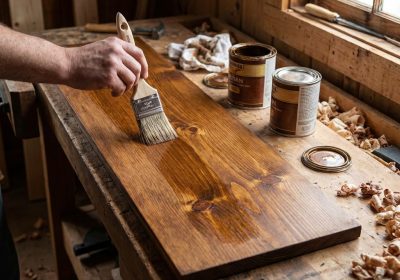
Application: Apply with a lint-free rag or foam brush, working with the grain. Wipe off excess after 5–10 minutes (check manufacturer instructions) before the stain begins to dry. Two coats provide deeper colour — always test on a scrap piece from the same board first. Follow with a top coat (polyurethane, lacquer, or hard wax oil) for protection.
Timber choice: Pine takes warm brown stains unevenly without a pre-conditioner — see the section below on pre-conditioning. Oak and spotted gum take these stains beautifully and produce a rich, complex result where the grain pattern is still visible through the stain.
Dark Espresso and Ebony: Modern Contrast
Dark stains have come back decisively in contemporary interiors — used selectively on furniture against light walls, on accent pieces, and on floating shelves and cabinetry hardware. The key to dark stains looking modern rather than dated is application quality: blotchy or uneven dark stains look terrible, while a perfectly even dark espresso finish on a clean-grained timber is stunning.
Application: Dark stains are the least forgiving of application errors. Always use a pre-conditioner on pine and other uneven-grained timbers. Apply the stain in thin, even coats — flooding the surface produces dark patches at the grain. Wipe off thoroughly, allow to dry, then add a second coat if needed. Use a foam pad rather than a brush for the most even application. Finish with a semi-gloss or satin clear coat — dark stains under a matte finish can look chalky.
Timber choice: Open-grained hardwoods like oak and ash take dark stains magnificently — the grain remains visible as dark lines through the espresso base. Maple and harder, close-grained timbers tend to go uniformly dark with little grain definition visible — good or bad depending on your goal. Pine with pre-conditioner takes dark stains adequately, but the result is rarely as good as hardwood.
Grey-Wash: The Coastal and Farmhouse Go-To
Grey-wash stains exploded in popularity with the coastal and Hamptons interior trends, and in 2026 they remain heavily used in Australian homes — particularly in Queensland and coastal NSW where the beach house aesthetic dominates. The grey-wash look replicates the effect of years of weathering in a single afternoon.
Application: Grey stains work in two ways: as a direct application penetrating stain, or as a diluted white paint wash wiped back to reveal the grain. For the most reliable result, use a purpose-formulated grey timber stain (Cabot’s Driftwood Grey, Feast Watson Weathered Grey) rather than trying to dilute paint — the purpose-made products penetrate evenly. Apply with a brush along the grain, wipe back across the grain with a cloth to remove excess from the surface while leaving stain in the grain lines, then wipe along the grain again for a uniform finish.
Timber choice: Pine takes grey stains well because the grain contrast creates a pleasing depth — the late-wood grain lines take more stain than the early wood, creating a subtle two-tone effect. Ash is spectacular with grey stains due to its very pronounced open grain. On very dark or very red timbers (jarrah, spotted gum), grey stain produces muddy results — use on pale timbers for the best outcome.
White-Wash: Boho and Beach
White-wash creates a milky, bleached-wood look that’s highly sought after for bohemian, beach house, and Scandinavian-influenced spaces. The timber grain remains clearly visible through the white, giving the piece a linen-like quality. Overdone it looks washed out — done well it’s warm, light, and organic.
Application: Mix white chalk paint or white acrylic with water at approximately 1:3 ratio (adjust based on your test results). Brush on along the grain, then immediately wipe back with a cloth to the opacity you want. The more you wipe back, the subtler the white effect. Let dry completely, then seal with a clear matte finish — this prevents the white from rubbing off in use. Never use high-gloss clear coats over white-wash; the sheen fights the soft, natural aesthetic.
Timber choice: Pine and ash work best. Pine’s grain structure soaks up the white nicely into the softer early-wood while leaving the late-wood grain visible. Hardwoods with very fine grain (maple, Tas oak) can look too uniformly white with less grain definition — use a thinner wash mix on these timbers.
Black: Industrial and Bold
Black-stained timber is the most dramatic option and works specifically in modern and industrial interior contexts — think warehouse apartments, architectural feature walls, and bold contemporary furniture. Black stain is not a universal choice and should be used with intention.
Application: Use a purpose-formulated black timber stain (Feast Watson Black Japan is widely available in Australia) rather than black paint — the penetrating stain preserves the wood’s texture and grain, while paint builds up on the surface and eventually chips. Apply two thin coats with a foam pad for even coverage. Finish with a satin clear coat. Black stains on raw timber can raise the grain aggressively — always sand to 220-grit, apply a wash coat of clear sealer, sand again to 320-grit, then apply the black stain for the smoothest result.
Timber choice: The grain must be strong enough to read through the black — otherwise the piece just looks painted. Oak is the standout choice for black stains: the open ring-porous grain structure creates a striking texture where the lighter grain lines show through the black base. Ash and spotted gum also work well. Avoid close-grained timbers like maple for black stains — the result looks like black plastic.
How Different Woods Take the Same Stain
This is the single most important thing to understand about timber finishing: two boards sitting side by side in a workshop will take the same stain completely differently depending on their species. This is not a failure — it’s how wood works — but it will surprise you the first time you see it.
Pine (Radiata Pine)
Pine is the trickiest species to stain evenly because it has high resin content and extremely variable porosity between early wood (soft, light, very porous) and late wood (harder, dense, less porous). The early wood soaks up stain rapidly, turning much darker than the late wood grain lines — creating a blotchy, streaky result with most stains. The solution is a pre-conditioner (Feast Watson and Cabot’s both make them): apply before staining, allow to dry, then apply stain immediately. The pre-conditioner partially seals the most porous areas to even out the absorption. On pine, always use a pre-conditioner before any stain darker than a natural oil finish.
Oak
Oak is the most forgiving staining timber — it takes stain evenly, consistently, and beautifully in any colour. The open, ring-porous grain structure allows stain to penetrate deeply into the grain channels while sitting more lightly on the face, creating natural depth and texture. Oak responds well to every colour category from natural blonde through to dark espresso and black. No pre-conditioner needed.
Spotted Gum and Other Australian Hardwoods
Australian native hardwoods (spotted gum, brush box, grey ironbark, blackwood) have dense, interlocked grain and high natural oil content. Stain penetrates less deeply than in European or American timbers — the natural colour and grain of the timber remains dominant even after staining. This is often a feature rather than a problem: the natural red and gold tones of spotted gum under a clear oil finish are genuinely world-class. If you’re trying to achieve a specific stain colour on Australian hardwood, test extensively first — you may find a direct oil finish beats any colour stain for the natural beauty of these species.
Finishing Tips for a Cleaner Outcome
- Always sand to 180-grit minimum before staining — stain on a rough surface blotches badly in the scratches.
- Wipe the sanded surface with a tack cloth to remove all dust before staining — dust particles cause bubbles and texture in the finish.
- Test every stain on a piece from the same board you’re finishing — stain varies significantly between batches and between timber pieces.
- Apply stain with the grain — never across it.
- If the stain dries too dark, lightly sand with 220-grit and wipe back — this lifts the surface colour without removing deep penetration.
- Always seal — stain alone is not a finish coat. Follow with a clear coat suited to the use (polyurethane for surfaces that get heavy use, hard wax oil for a more natural feel, exterior clear coat for outdoor pieces).
Start Your Next Project
Staining is where good woodworking becomes great — a beautifully finished piece in the right colour for the space is what separates a professional-looking result from a home project that looks “a bit rough”. The best finishing decisions start with good project planning and quality timber preparation. Ted’s Woodworking includes finishing guides alongside every project plan — so you know exactly what stain, oil, or top coat suits each build before you start. Well worth having access to when you want to make your next project your best one.