A toy box seems like a simple build — a box with a lid — until you realise that standard hinges make that lid a serious danger to small fingers. Children have lost fingertips to toy box lids falling shut. This is not a small risk; it’s a well-documented hazard that the US Consumer Product Safety Commission has issued specific warnings about, and Australian safety standards reflect the same concerns. This guide shows you how to build a toy box correctly, with a slow-close lid support mechanism, ventilation holes, and a finish that’s safe for kids to touch every single day.
Understanding the Lid Safety Requirement
A standard piano hinge allows the lid to fall freely under its own weight. A 600mm-wide toy box lid made from 18mm plywood weighs approximately 3–4kg. When it falls from fully open, the force at the leading edge is enough to break small fingers. The solution is a lid support hinge — sometimes called a stay or chest hinge — that holds the lid at any angle and has a slow-close mechanism that controls the descent speed. This is a non-negotiable safety feature on any toy box used by children under 10.
Cut List
| Part | Qty | Length | Width | Thickness | Material |
|---|---|---|---|---|---|
| Front panel | 1 | 720mm | 420mm | 18mm | 18mm birch ply or pine DAR |
| Back panel | 1 | 720mm | 420mm | 18mm | 18mm birch ply or pine DAR |
| Side panels | 2 | 400mm | 420mm | 18mm | 18mm birch ply or pine DAR |
| Base panel | 1 | 720mm | 400mm | 18mm | 18mm birch ply or pine DAR |
| Lid | 1 | 756mm | 436mm | 18mm | 18mm birch ply or pine DAR |
| Base feet / skids | 2 | 720mm | 40mm | 18mm | Pine DAR |
The finished box is 756mm wide × 436mm deep × 438mm tall (excluding lid). The lid overhangs by 18mm front and sides to create a slight lip. The base is raised on two skid rails to allow airflow underneath and make it easier to slide on hard floors.
Where to Buy Lid Support Hardware in Australia
Lid support hinges with slow-close mechanisms are available from several Australian suppliers:
- Bunnings Warehouse — stocks Hettich and generic lid stay hinges in the cabinet hardware aisle. Look for “lid stay” or “chest hinge” in the hinge section. Approximately $12–$18 per pair.
- Hafele Australia (hafele.com.au) — professional-grade slow-close lid supports including the Häfele Free Flap range, which has pneumatic damping. Sold through their trade counter and some hardware stores. Approximately $25–$45 per pair.
- Hardware and General (hardwareandgeneral.com.au) — wide range of chest hinges and lid supports, shipped nationally.
- Amazon Australia — search “soft close chest hinge” or “toy box lid support” for multiple options between $10–$30.
Buy two lid support hinges — one for each side of the lid. This distributes the load evenly and ensures the lid stays flat as it opens and closes.
Step-by-Step Build Instructions
- Cut all panels to size. Use the cut list above. If using plywood, orient the good face outward on all panels. Mark each piece with its position (front, back, left side, right side, base, lid) before cutting.
- Sand all panel faces before assembly. Work through 80, 120, and 180 grit. It’s much easier to sand flat panels now than to reach inside corners after the box is assembled.
- Round all exposed edges. Use a router with a 6mm roundover bit, or sand to a generous radius with a sanding block. All external edges and corners must be rounded. The lid edges in particular should be smooth — this is where small hands grab most often.
- Drill ventilation holes in the back panel. This is a critical safety step. Drill 6–8 holes of 25mm diameter across the back panel, evenly spaced, positioned in the upper half of the panel. These holes ensure that if a child climbs inside the box and the lid closes, they have an adequate air supply. Use a spade bit or Forstner bit for clean holes. Sand the hole edges smooth with a dowel wrapped in sandpaper.
- Drill pocket holes for assembly. Use a pocket hole jig (set for 18mm stock) to drill pocket holes along the bottom edge of the front and back panels, and along the mating edges of the side panels. Two pocket holes per joint at a minimum, three for the longer front and back panels.
- Assemble the box carcass. Apply PVA glue to all mating surfaces. Assemble the front and back panels to the side panels first, checking for square. Then glue and screw the base panel up into the assembled carcass from below. Clamp and allow the glue to cure for at least one hour.
- Attach the base skid rails. Glue and screw the two skid rails across the bottom of the base panel, running front-to-back, spaced about 100mm in from each side. These lift the box slightly off the floor and protect the base from moisture.
- Install the lid support hinges. Follow the manufacturer’s instructions for your chosen lid supports exactly. Most slow-close lid supports mount to the inside of the side panels and to the underside of the lid. Position them so the lid sits flush with the back of the box when closed. Test the slow-close action before final installation: the lid should descend slowly and stop gently, never falling under its own weight.
- Attach the lid to the back panel. Use two standard butt hinges to attach the lid to the back panel as the pivot point. The lid support hinges provide the slow-close function; the butt hinges provide the pivot. Align carefully so the lid sits flat and the gap is even all around.
- Final sand and prepare for finishing. Give the entire piece a final sand with 180 grit. Slightly ease the lid-to-box gap edges with 220-grit sandpaper so they don’t bind.
- Apply finish. See finishing section below.
Finishing the Toy Box
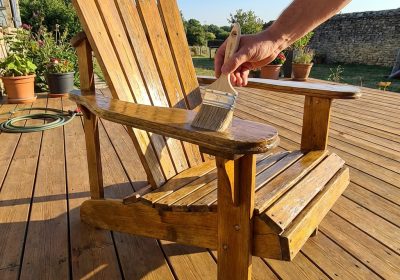
A toy box will be touched by small hands many hundreds of times a year. Choose a finish that is both durable and genuinely non-toxic once fully cured. The best options for an Australian climate:
- Low-VOC water-based interior paint — Dulux Wash & Wear, Taubmans Endure, or Haymes Supacoat. Apply a primer coat, then two colour coats. Allow 24–48 hours ventilation after final coat. These paints are not toxic once fully cured.
- Hardwax oil (clear or tinted) — Osmo Polyx-Oil is food-safe once cured, enhances the natural wood grain, and is very easy to maintain and repair. Best choice if you want a natural timber look.
- Child-safe enamel — for a hard, glossy finish. Look for ACMI AP-certified products.
Do not use solvent-based polyurethane, lacquer, or oil-based enamel. Even when “dry,” these products can continue off-gassing VOCs for weeks in enclosed spaces.
One More Safety Check Before First Use
Before loading the box with toys and letting a child near it, run through this checklist: test the slow-close mechanism ten times; check that no screw points protrude into the interior; verify all interior edges are smooth; confirm the ventilation holes are clear; and test the lid at its fully open position — it should stay open without falling back.
Ready to Build the Full Playroom?
A toy box pairs beautifully with a matching bookshelf, step stool, or play table. If you want access to hundreds of children’s furniture plans with full cut lists and safety-verified designs, Ted’s Woodworking is the most comprehensive plan library available for home builders. Over 16,000 plans, beginner-friendly instructions, and everything you need to outfit an entire playroom.