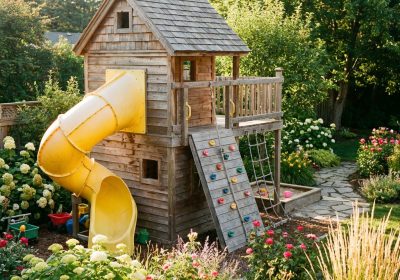
A backyard treehouse is one of those projects that sounds ambitious but is genuinely achievable for a motivated beginner — as long as safety comes first, every step of the way. The difference between a treehouse that lasts twenty years and one that collapses in a storm often comes down to a few key decisions: how you attach it to the tree, how high you build the platform, and whether you get a council permit before you start. This guide covers all of it, with the detail that most beginner treehouse articles skip.
Before You Start: Is Your Tree Suitable?
Not every tree can support a treehouse. Building in an unsuitable tree is the single biggest cause of treehouse structural failures. Before you pick up a tool, assess your tree against these criteria:
- Trunk diameter: The main trunk at the attachment point must be at least 300mm in diameter. Thinner trunks flex too much and can split around fasteners under load.
- Species: Hardwoods (gum, ironbark, spotted gum, jacaranda) are ideal. Avoid softwoods with brittle wood structure. Never build in a palm — palms don’t have the structural fibre to hold fasteners securely.
- Health: The tree must be visibly healthy — no dead branches, no fungal growth at the base or on the trunk, no large hollow cavities, and no significant lean. A certified arborist can assess this for around $100–$200 and is money well spent for a project of this scale.
- Not hollow: Tap the trunk with a mallet. A solid thud indicates healthy wood; a hollow resonant sound indicates internal decay. Do not build in a hollow tree.
- Root system: The tree should not be recently transplanted and should have a well-established root system. Avoid trees with surface roots that are being lifted — this indicates stress.
Australian Building Code — Do You Need a Permit?
This is the question most online treehouse guides dodge. In Australia, the answer depends on your state and local council, but the general rule is:
In most Australian states, structures that are over 10m² in floor area OR raised more than 1.0m above natural ground level may require a Development Application (DA) or Building Permit. Some councils have specific exemptions for “play equipment,” but these vary significantly. A platform at 1.5m high (the recommended maximum for under-12 use) technically triggers the height threshold in many jurisdictions.
Before you build, call your local council and describe what you’re planning — dimensions, height, whether it’s attached to a tree or freestanding. Ask specifically whether a permit is required. This takes 10 minutes and can save you a significant fine or a council-ordered demolition. In Queensland, NSW, and Victoria, the most common requirement for a permitted treehouse is an engineer’s certification of the structural design — budget $300–$500 if this applies to you.
Platform Height: Keep It Low
For children under 12, keep the platform no higher than 1.5m above ground. This is not an arbitrary number — it’s the threshold at which falls become significantly more dangerous. A 1.5m fall onto soft ground or bark chip is survivable; a 2.5m fall onto hard ground can cause serious injury. A 1.5m platform also keeps you below the permit trigger height in most jurisdictions.
For under-6 children, consider a platform at 0.8–1.0m. You can always raise it as the children get older and better at navigating heights.
TABs vs Coach Bolts: Use TABs
Tree Attachment Bolts (TABs) are purpose-engineered fasteners for treehouse construction. A single TAB can support 500–900kg of dead load, depending on species and diameter. More importantly, TABs compress the wood fibres minimally and allow the tree to grow around them without significant structural damage. They also allow a small amount of movement — the tree sways in wind, and TABs accommodate that movement rather than fighting it.
Coach bolts (carriage bolts) are the old way of attaching treehouses. They work, but they create multiple small puncture wounds in the tree rather than one large engineered connection, and they don’t allow for growth or movement. Over several years, coach bolts can cause decay channels into the heartwood. If you’re building something that will last, use TABs.
TABs are available from specialist treehouse suppliers in Australia (search “treehouse TAB bolt Australia”) and some rural/farm hardware suppliers. Expect to pay $80–$150 per bolt, and you’ll typically need 2–4 for a standard single-tree platform.
Safety Checklist: What Every Treehouse Must Have
| Safety Feature | Specification | Why It Matters |
|---|---|---|
| Perimeter handrails | Minimum 900mm tall on all open edges | Prevents falls from platform edges |
| Railing balusters / gaps | Maximum 100mm between any balusters or rails | Prevents a child’s head fitting through and becoming trapped |
| Platform decking gaps | Maximum 10mm gap between deck boards | Prevents small feet or toes being trapped |
| Ladder | Fixed, angled at 70–75°, with secure handrails both sides | Rope ladders are fun but dangerous for under-8s — fixed is safer |
| Ladder top | Handrails extend 300mm above platform level | Provides a grab point when transitioning from ladder to platform |
| Entry opening | Minimum 600mm × 600mm hatch or entry gap | Allows easy passage; adults can follow children up |
| No protruding fasteners | All screws/bolts recessed or capped | Prevents cuts and punctures on exposed hardware |
| Timber treatment | H3 treated pine for all structural members | Structural timber must be rated for ground-near and outdoor use |
| Regular inspection schedule | Full inspection every 6 months | Timber deteriorates; fasteners loosen; connections need checking |
Basic Structural Build Sequence
- Install the TABs. Drill the TAB holes with a long auger bit at the specified diameter for your chosen TABs. Drive TABs in with a large socket wrench — they cut their own thread as they go. Position them so the support beams will sit level. Allow the tree at least one week to begin its natural compartmentalisation response before loading the TABs.
- Install the primary support beams. These are 190×45mm H3 treated pine beams sitting on the TAB brackets. For a single-tree platform, you’ll typically have two parallel beams passing each side of the trunk, connected to the TABs. Check for level in both directions.
- Frame the platform. Add secondary joists (90×45mm H3 treated pine) across the primary beams at 450mm centres. Joist hangers give the strongest connection. The overall platform size for a beginner build is recommended at 1800mm × 1800mm — compact, structurally manageable, and large enough for meaningful play.
- Lay the deck boards. Use 90×19mm hardwood decking or H3 treated pine decking. Leave no more than 10mm gaps. Screw with 65mm decking screws, countersunk flush. Do not leave screw heads proud of the surface.
- Build and install perimeter handrails. Posts should be 90×90mm timber, notched over the outside joist and through-bolted. Rails at 450mm and 900mm height. Balusters at maximum 100mm spacing, screwed top and bottom.
- Build the fixed ladder. Cut two 2400mm side rails from 90×45mm timber. Cut the top of each at an angle to sit flush against the platform edge at 70–75°. Drill rung holes at 300mm centres and glue and screw 35mm hardwood dowel rungs. Mount the top of the ladder with through-bolts into the platform framing, and anchor the base to a concrete pad to prevent it shifting.
- Install any roofing or walls. A simple skillion roof (flat with slight fall for drainage) over half the platform provides weather protection without requiring complex framing. Use corrugated iron or heavy-duty polycarbonate on a simple rafter framework.
- Final safety check. Go through the full checklist table above before the first use. Shake every rail hard. Stand on every deck board. Check every fastener.
Soft Landing Zone
Regardless of how safe the platform is, install a soft landing surface beneath and around the treehouse. Bark chip mulch 300mm deep, or playground-grade rubber matting, dramatically reduces injury severity if a child does fall. The landing zone should extend at least 1.8m from any climbable surface.
Ready to Plan the Full Build?
A treehouse is one of the most complex backyard woodworking projects you can take on, and having detailed, engineer-reviewed plans makes a significant difference. Ted’s Woodworking includes multiple treehouse designs in its library of over 16,000 plans — including platform designs, ladder specifications, and structural details that take the guesswork out of the hardest decisions. It’s the reference every DIY treehouse builder should have on hand.