A backyard playhouse is one of the highest-value projects you can build for your children — something they’ll use daily for years and remember for decades. The challenge is that “playhouse” covers an enormous range of ambition, from a simple three-wall box to a full castle with turrets and a drawbridge. This guide covers five styles from simplest to most complex, with enough detail on each to help you choose what’s right for your skill level, your budget, and your backyard. If you’re a beginner, start with the simple box playhouse — we’ll cover the build sequence in full detail.
Five Playhouse Styles: Overview and Comparison
| Style | Floor Area | Key Features | Difficulty | Approx Cost (AU$) |
|---|---|---|---|---|
| Simple Box Playhouse | 1.8m × 1.2m | Flat/skillion roof, 1 door, 1–2 windows, ground level | Beginner | $400–$600 |
| Cottage with Porch | 2.4m × 1.8m + 1.0m porch | Gable roof, front porch with balustrade, window boxes | Intermediate | $900–$1,400 |
| Castle Playhouse | 2.4m × 2.4m | Battlements, tower, “stone” render or cladding, drawbridge | Advanced | $1,800–$3,000 |
| Pirate Ship Playhouse | 2.0m × 1.2m hull + bow | Prow, ship’s wheel, crow’s nest platform, rope rigging | Advanced | $1,500–$2,500 |
| Tree Platform Playhouse | 1.8m × 1.8m elevated | Tree-mounted or post-elevated, ladder, simple roof | Intermediate–Advanced | $1,200–$2,000 |
Style 1: Simple Box Playhouse (Start Here)
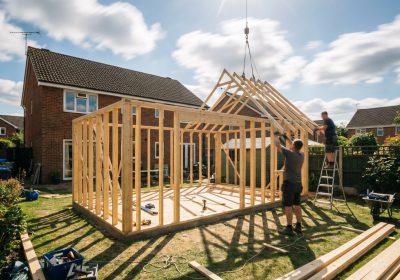
This is the playhouse that every beginner should build first. It’s structurally straightforward, uses standard Bunnings materials, and can be completed in a weekend. The finished structure is 1.8m wide × 1.2m deep × 1.4m tall at the front, with a skillion (flat/slightly sloped) roof. Ground-level, no footings beyond treated pine skids or simple concrete pads. See the complete build sequence in the section below.
What makes it distinctive: Simplicity is the point. No complex roof geometry, no elevated platform, no special joinery. It’s a genuine timber structure that will last 10–15 years with basic maintenance.
Key materials: 90×45mm MGP10 framing pine, 9mm exterior-grade ply for wall sheeting, roofing iron or polycarbonate for the roof, and exterior water-based paint in your child’s chosen colour.
Style 2: Cottage Playhouse with Porch
The cottage playhouse adds a gable roof and a covered front porch, which transforms the structure from a box into something that genuinely looks like a little house. The porch creates a transitional outdoor space that kids love — a place to sit and survey the backyard without being fully inside.
What makes it distinctive: The gable roof requires cutting rafter pairs to matching angles — not difficult, but it requires a mitre saw and a clear understanding of roof geometry. The porch adds a front overhang with simple posts and a low balustrade rail. Window box planters on the front windows are a charming detail that takes an extra hour.
Structural challenge: The ridge board connection and the rafter bird’s mouth cuts are the hardest parts. Cut all rafters in matching pairs and dry-fit before nailing off. Use a rafter square (speed square) to mark consistent angles.
Key materials: Same framing materials as the simple box, plus T&G weatherboard cladding or fibre cement weatherboard for a more cottage-like exterior, and roofing iron with bargeboards.
Style 3: Castle Playhouse
A castle playhouse is an ambitious project that delivers enormous delight. The distinctive features are the crenellated parapet (the stepped battlements at the top of the walls), at least one cylindrical or square tower, and a drawbridge-style front door. Some builders add faux stone cladding using fibre cement panels scored to look like stonework, or simply use textured paint.
Structural challenge: The primary challenge is building the parapet (battlements) — this requires careful marking and cutting of the wall tops, and the crenellations must be structurally integrated into the wall framing rather than just decorative trim. The tower requires its own square frame and connection to the main structure. Budget 3–4 weekends minimum.
Key materials: Heavier framing (90×70mm for the tower), 9mm exterior ply throughout, hinged drawbridge door on heavy-duty strap hinges, rope for the drawbridge chains. If adding a crow’s nest or upper platform, use H3 treated timber and full handrails.
Style 4: Pirate Ship Playhouse
A pirate ship playhouse is all about the aesthetic — the pointed bow, the ship’s wheel, the crow’s nest, and rope rigging. The structural footprint is surprisingly simple (a rectangular box), but the visual details require careful carpentry. The bow is typically a triangular timber frame clad in exterior ply that extends in front of the main structure.
Structural challenge: The crow’s nest (a small platform elevated above the roof of the main cabin) requires its own post-and-rail structure and full handrails. Do not build a crow’s nest above 1.5m total platform height without handrails. The ship’s wheel is a decorative element — buy a pre-made timber ship’s wheel from a marine or prop supplier, or cut one from 18mm ply.
Key materials: 9mm ply for all curved bow cladding (curved in one plane only — ply can’t take compound curves), natural fibre rope for rigging, and marine-grade paint in classic navy, red, and white for the exterior.
Style 5: Tree Platform Playhouse
A tree platform playhouse elevates the structure either into a suitable tree (using TABs — tree attachment bolts) or on 4×4 treated timber posts set in concrete. This is the style that gets closest to the treehouse ideal — an elevated space reached by a ladder, with a simple roof and walls for shelter.
Structural challenge: If tree-mounted, the tree assessment and TAB installation are the hardest parts (see our treehouse guide for full details). If post-mounted, sinking four 100×100mm H5-treated posts in concrete is straightforward but requires careful levelling. The elevated platform requires full perimeter handrails at minimum 900mm height with no more than 100mm baluster spacing.
Key materials: H5 treated pine posts (for ground contact), H3 treated framing for the platform, standard framing pine for walls and roof, and hardwood decking for the platform floor.
The Simple Box Playhouse: Full Build Sequence
If you’re a beginner, here is the complete sequence for the simple box playhouse. This is the “start here” design — once you’ve built this, you’ll have every skill needed to tackle the more complex styles.
- Site preparation: Clear a 2.0m × 1.4m area of vegetation. Lay two H4 treated pine bearer skids (140×45mm, 1.8m long) on a level bed of road base gravel, running front-to-back. Check level across all four bearing points.
- Build the floor frame: Install three 90×45mm H3 treated floor joists across the bearers at 600mm centres using joist hangers. Lay and screw down a sheet of 19mm structural ply as the floor.
- Frame the front wall: Bottom plate 1800mm long, top plate 1800mm long, studs at 600mm centres at 1400mm height. Frame a 600mm × 900mm door opening in the centre.
- Frame the rear wall: Same as front wall but studs at 1250mm height (creating the slope for the skillion roof). No door opening required.
- Frame the side walls: 1200mm long bottom and top plates. The top plate angles from 1400mm at the front to 1250mm at the rear. Cut the top of the corner studs to this angle.
- Stand and connect all four walls to the floor frame and to each other. Brace with temporary diagonals, check for plumb and square, then fix permanently.
- Install roof rafters: Three 90×45mm rafters spanning front to back, screwed to the top plates with rafter ties. Allow 100mm front overhang.
- Sheet walls and roof: Fix 9mm exterior ply to the wall frames, cutting window and door openings as you go. Install roofing iron or polycarbonate over the rafters.
- Fit door and trim: Hang a ply door on two butt hinges. Fit pine trim around window openings.
- Sand, prime, and paint: Round all external corners. Apply exterior primer, then two coats of exterior water-based paint.
Ready to Go Further?
Whichever style you’re drawn to, having detailed plans makes the build enormously easier. Ted’s Woodworking includes playhouse plans for every style and skill level — with complete cut lists, framing diagrams, and step-by-step instructions. Over 16,000 projects in one library — the most comprehensive resource available for Australian backyard builders.