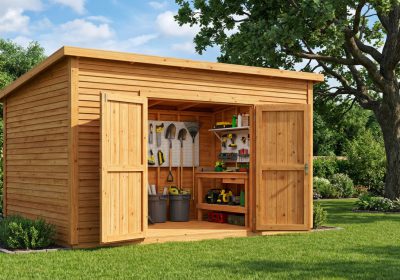
An 8×10 shed is the most popular backyard storage size in Australia for good reason: it’s compact enough to fit in a modest suburban block, large enough to actually hold the gear most households accumulate, and sits just under the permit threshold in most council areas. At 7.4m², it stores a push mower, a set of garden tools, two bikes, and still leaves room to turn around — provided you plan the layout well. This guide covers everything you need to frame and finish an 8×10 shed from scratch, using standard Australian timber sizing.
What Fits in an 8×10 Shed?
Before you commit to the build, it helps to know whether this shed will actually hold what you need. A well-organised 8×10 shed can accommodate:
- One push lawnmower or electric mower
- Two bicycles (hung on wall hooks, not floor-standing)
- A full set of long-handled garden tools (spades, rakes, forks)
- A potting bench or narrow work surface (max 500mm deep)
- Shelving for garden chemicals, pots, and small tool storage
- A bin for compost scraps or recyclables
What it won’t fit comfortably: a ride-on mower (needs a 10×12 minimum), a full workshop setup, or a standard wheelie bin with room to manoeuvre. For those needs, step up to a 10×12 or 12×16.
Permit Considerations
At 7.4m², an 8×10 shed typically falls below the 10m² permit-free threshold that most Australian councils apply to Class 10a outbuildings. However, this is not universal. Some councils set lower thresholds, and even structures under 10m² may need to comply with setback rules, height limits, and cladding requirements. Always confirm with your local council before you start building. In some South Australian and Western Australian council areas, the exempt threshold differs from the general 10m² guide. Getting this wrong can result in a demolition order.
Foundation Options
Timber Skids
The simplest option and perfect for an 8×10 shed. Use two or three 140×45mm hardwood or treated pine bearers (skids) laid flat on compacted gravel or prepared ground, spaced no more than 1200mm apart. Level them with a long spirit level — even a 5mm difference across the width will make your walls difficult to plumb. Skids are not permanent; the shed can be relocated if needed.
Concrete Footings
Poured footings with stirrups at each corner and mid-span are appropriate for sloping sites or areas with reactive clay soil. More work upfront but significantly more stable long-term. Use 300×300×300mm poured concrete footings minimum, with a post anchor set in the wet concrete aligned to your floor frame dimensions.
Concrete Slab
Overkill for an 8×10 shed unless you plan to use it as a workshop with heavy equipment. If you want one anyway, a 100mm slab with F72 mesh is standard for this application in most Australian residential contexts.
Wall Framing: Australian Standard
Australian residential framing uses 90×45mm MGP10 structural pine studs at 450mm centres — this is the standard spacing under AS 1684 for timber-framed structures. The 450mm centres (versus the 400mm or 600mm spacings sometimes seen in older Australian construction or US framing) are what your Colorbond or fibre cement cladding is engineered around.
For a standard 8×10 shed with 2.4m wall height, each wall uses:
- Bottom plate: one length of 90×45 running the full wall length
- Top plate: doubled 90×45 for load distribution
- Studs: 90×45 × 2340mm (to achieve 2400mm finished wall height with plates)
- Corner posts: three-stud or L-shaped corner assembly
- Door header: 190×45mm LVL or doubled 90×45 over the door opening
Cut List Summary
| Member | Size (mm) | Length (m) | Qty | Total Lineal Metres |
|---|---|---|---|---|
| Wall bottom plates | 90×45 | 2.4 / 3.0 | 2+2 | ~10.8 lm |
| Wall top plates (doubled) | 90×45 | 2.4 / 3.0 | 4+4 | ~21.6 lm |
| Wall studs | 90×45 | 2.34 | ~38 | ~88.9 lm |
| Door header | 190×45 LVL | 1.0–1.2 | 1 | ~1.2 lm |
| Rafters | 90×45 | ~1.8 (gable) | 10 | ~18 lm |
| Ridge board | 140×19 | 3.0 | 1 | 3.0 lm |
| Floor bearers (skids) | 140×45 H3 treated | 3.0 | 3 | 9.0 lm |
| Floor joists | 90×45 H3 treated | 2.4 | 7 | 16.8 lm |
This is a summary cut list for planning and quoting purposes. A full build requires a detailed plan showing exact rafter lengths, bird’s mouth cuts, blocking positions, and bracing. Timber lengths above assume a gable roof with a 22° pitch.
Roofing Options
Corrugated Galvanised Steel
The cheapest roofing option and perfectly serviceable for a storage shed. Standard corrugated sheets in 0.42mm base metal thickness (BMT) are available at most hardware stores. Requires a minimum roof pitch of 5° but performs better at 15° or more for drainage. Fix with Tek screws into purlins; use foam or rubber closures at the eaves to block insects.
Colorbond Steel
The premium Australian choice. Colorbond is a painted Zincalume steel product available in a wide range of colours that match most suburban homes. Use 0.42mm BMT Trimdek or Klip-Lok profile for sheds. More expensive than raw corrugated iron (roughly 30–40% more per sheet) but far more weather-resistant and visually appealing. Many councils prefer Colorbond in residential areas.
Shingles
Fibreglass or asphalt shingles are uncommon for Australian garden sheds but work fine on a gable roof with a pitch of 18° or more. They require a sarking layer underneath and plywood decking, which adds cost and weight. Generally not cost-competitive with steel roofing for a basic storage shed, but can match the look of a timber-clad home if aesthetics matter.
Build a Shed That Lasts — Start with a Complete Plan
The difference between a shed that stands for 20 years and one that starts racking and leaking in three seasons comes down to having proper plans with accurate structural dimensions. Guessing at rafter lengths, stud spacing, or header sizes creates real structural problems down the track.
Ted’s Woodworking includes full 8×10 shed plans with precise cut lists, framing diagrams, roof details, and foundation options — everything you need to buy the right materials and build it right the first time.
Get the complete 8×10 shed plan and 16,000+ other woodworking projects at Ted’s Woodworking →