A well-built workshop storage system is not just about tidiness — it is a direct productivity upgrade. When every tool has a place and every consumable is visible and accessible, you spend less time searching and more time building. Wall-to-wall garage cabinets also significantly improve safety: tools stored in open drawers and on pegboards are tripping hazards; tools behind cabinet doors are not. This guide walks you through planning and building a complete wall-to-wall cabinet system for a standard Australian garage workshop, focused on a practical 1200mm base unit that you can replicate across an entire wall.
Planning Your Cabinet Run
Before cutting a single board, spend time with a tape measure and a pencil sketch. A poorly planned cabinet run will leave awkward gaps, obstruct door swings, or create a bench height that does not suit your workflow.
Step 1: Measure the Wall
Measure the full wall length, marking the positions of power outlets, light switches, and any wall penetrations (pipes, conduit, air lines). Note the ceiling height — standard Australian garages have 2400mm ceilings, which gives you room for base cabinets (900mm), a work bench, and wall cabinets above.
Step 2: Decide on Heights
Standard workshop cabinet heights:
- Base cabinets: 870mm tall (to top of carcass). Add a 40mm hardwood bench top for a 910mm working height — comfortable for most adults standing.
- Wall cabinets above bench: 600–720mm tall, mounted with the base at 550mm above the benchtop (approximately 1460mm from the floor). Leave enough clearance to use tall power tools on the bench.
- Overhead storage (above wall cabinets): Use this zone for long-term storage and rarely-used items — the space between the top of wall cabinets and the ceiling.
Step 3: Leave Space for the Bench
Plan your bench section deliberately. A 1200mm–1800mm bench section in the middle of a wall run gives you a clear work surface. The bench section has no upper cabinet directly above it to allow for taller work tasks.
Plywood Carcass Construction
Workshop cabinets live in a harsher environment than kitchen cabinets — temperature swings, humidity, oil vapour, sawdust. Use 18mm structural plywood for all carcass panels, not MDF. Plywood holds screws better at edges, handles humidity cycling without delaminating, and does not turn to mush if a wet rag sits on it overnight.
Joinery: Biscuits vs Dominoes
For carcass panel-to-panel joints, the two best options for a DIY builder are:
Biscuit joints: A biscuit joiner (Lamello, Dewalt or similar) cuts matching crescent-shaped slots in mating faces. Compressed beech biscuits are glued in and swell on contact with water-based glue, creating a tight joint. Biscuits provide alignment accuracy and some additional glue surface area. A biscuit joiner costs $150–$300 and is genuinely useful for cabinet work beyond this project.
Domino joints (Festool DF500): More expensive tool ($1,000+) but produces a significantly stronger and more precise joint than biscuits. If you have access to a Domino or can borrow one, use it. If not, biscuits and screws is perfectly adequate for workshop cabinets.
For most builders, pocket holes and construction adhesive at every joint is the fastest and strongest option for workshop cabinets where appearance is secondary to structural integrity.
Cut List: 1200mm Base Cabinet
| Part | Qty | Dimensions (mm) | Material |
|---|---|---|---|
| Side panels | 2 | 870 × 560 × 18 | 18mm structural ply |
| Top panel | 1 | 1164 × 560 × 18 | 18mm structural ply |
| Bottom panel | 1 | 1164 × 560 × 18 | 18mm structural ply |
| Back panel | 1 | 1200 × 906 × 9 | 9mm ply |
| Fixed middle shelf | 1 | 1164 × 542 × 18 | 18mm structural ply |
| Adjustable shelves | 2 | 1164 × 542 × 18 | 18mm structural ply |
| Kickboard | 1 | 1200 × 100 × 18 | Ply or MDF |
Repeat this unit across the wall, or scale to different widths (600mm, 900mm, 1500mm) as needed for your wall layout. Keep the height and depth consistent across all units so the bench top runs continuous.
Door Options
Plain Plywood Doors
The simplest and most cost-effective door for workshop cabinets: cut 18mm ply to the door opening dimensions plus a standard overlay (typically 12mm overlap on each side of the face frame opening). Sand, prime and paint two coats of semi-gloss. These doors are robust, easy to repair if damaged, and take about 20 minutes per door to make.
Bifold Doors
On wide cabinets (1200mm and above), bifold doors are practical — they open without swinging out into the workspace. Each door leaf is half the cabinet width. A piano hinge connects the two leaves; standard European hinges mount each outer leaf to the face frame. This requires precise measurement but the result is clean and functional.
Open Shelving
Leave some sections without doors — open shelving is faster to access for frequently-used items (safety glasses, measuring tape, pencils, sandpaper). A mix of open shelving for consumables and closed cabinets for power tools is the most functional configuration for a working workshop.
Bench Top: Hardwood vs Melamine
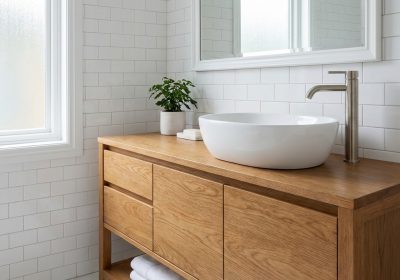
40mm Hardwood
Jarrah, spotted gum, blackbutt and other Australian hardwoods make outstanding bench tops. At 40mm thickness they are virtually indestructible under workshop use, can be planed flat if they cup slightly, and look exceptional. Source from a hardwood timber yard — specify the timber has been dried to 12% MC or below to minimise post-installation movement. Finish with two coats of hardwax oil (Rubio Monocoat or similar), which penetrates rather than sitting on the surface. The main cost is the timber: expect $200–$400 for a 1800mm length of 40mm hardwood at 600mm wide.
Polytec Melamine
A 33mm melamine-faced particleboard bench top from Polytec or a similar manufacturer is far cheaper ($80–$150 for a standard length) and is very resistant to scratches and most chemicals. It is not as durable under heavy impact as hardwood, and it cannot be resurfaced if badly damaged. For a light-duty workshop bench or a run of upper cabinets, it is a perfectly reasonable choice.
Levelling and Securing to the Wall
Workshop cabinets carry significant weight — a drawer full of hand tools can weigh 30–40kg, and a cabinet full of paint cans even more. Levelling and wall anchoring is not optional; it is a structural and safety requirement.
- Start with the corner cabinet. Set it in position and use a spirit level across the top to check level side-to-side and front-to-back. Insert plastic shims under the base to level as needed.
- Screw through the back panel into a wall stud using 75mm × 10-gauge screws. Two screws per stud, minimum two studs per cabinet.
- Slide the next cabinet into position. Clamp it to the previous cabinet and check that their tops are coplanar (flush). Screw the face frames together (two screws through the stile of one into the stile of the next) before wall-fixing.
- Once all cabinets are in line, level and secured, scribe the kickboard to follow any floor irregularities and snap it into the kickboard clips.
Locate wall studs using a quality stud finder (the Zircon MultiScanner 740 is reliable) or by tapping and listening for the change in sound. Never rely on plastic hollow-wall anchors alone for heavy workshop storage — find the studs and fix into them.
A Weekend Investment With Years of Return
A full wall of workshop cabinets built to this specification will cost approximately $400–$700 in materials for a 4-metre run. A comparable fitted workshop system from a specialist supplier runs $2,000–$5,000. The quality of a well-built plywood workshop cabinet exceeds most commercial products — and it is built to your exact dimensions and workflow.
Want Full Plans for Your Workshop Build?
If you want detailed plans for workshop storage, benches, tool cabinets and more — including downloadable cut lists and diagrams — Ted’s Woodworking has over 16,000 plans covering every area of the workshop and home. It is the most comprehensive plan resource available for home woodworkers.