Storage cabinets are the most universally useful furniture you can build. Unlike a dining table or bed frame — which have one obvious job — a storage cabinet solves a different problem in every room, and each environment has its own set of requirements for dimensions, materials, and construction details. This guide covers seven cabinet types across every main room of a home: what to build, what dimensions matter most, what material to use, and the one beginner mistake that is specific to each type.
Room-by-Room Storage Cabinet Overview
| Room | Cabinet Type | Key Dimensions (mm) | Best Material | Difficulty |
|---|---|---|---|---|
| Lounge | TV console / media unit | 1800W × 500H × 400D | 18mm ply + solid pine face | Beginner |
| Bedroom | Wardrobe / robe | 1800W × 2100H × 580D | 18mm ply carcass, MDF doors | Intermediate |
| Kitchen | Pantry cabinet | 600W × 2000H × 400D | 18mm ply or MDF | Intermediate |
| Hallway | Linen press | 900W × 2000H × 400D | 18mm ply carcass, MDF doors | Intermediate |
| Garage | Workbench cabinet | 1200W × 870H × 600D | 18mm structural ply | Beginner |
| Bathroom | Vanity cabinet | 900W × 870H × 450D | MR MDF or ply + solid pine face | Intermediate |
| Outdoor | Garden storage cabinet | 1200W × 900H × 450D | Treated pine or hardwood | Beginner–Intermediate |
TV Console (Lounge Room)
A TV console sits low — typically 450–500mm tall — so the television screen is at a comfortable viewing height from a couch. The standard viewing distance of 2.5–3m for a 65-inch screen puts the ideal TV centre height at about 1050–1100mm from the floor; subtract half the TV height, and your console top should be 500–600mm high.
Key dimension: Width. Size the console to your TV width plus 200mm each side for visual breathing room. An 85-inch TV is approximately 1900mm wide, so a 2200mm console works perfectly.
Material recommendation: 18mm structural plywood carcass with solid pine face frame and ply doors. The open-grain texture of ply (birch ply for the best look) suits modern and coastal interiors. Add cable management holes (80mm hole saw) through the back panel and internal shelves to route power and HDMI cables.
Beginner tip: Do not make the cabinet too deep. 400mm is sufficient for most home theatre equipment. Going deeper makes it look like a kitchen base cabinet, not a piece of lounge furniture. Keep the legs short and visible (50–100mm) to give it a mid-century feel.
Wardrobe (Bedroom)
A built-in wardrobe is one of the most space-efficient storage upgrades possible in a bedroom. Australian standard wardrobe depth is 580mm — this accommodates clothes on hangers perpendicular to the wall (a hung coat hanger is approximately 480mm wide) with room for the door to close. Anything shallower than 550mm will force you to angle hangers, which reduces capacity significantly.
Key dimension: Internal hanging height. Standard ceiling height in Australian bedrooms is 2400mm. A wall-to-ceiling wardrobe with a 2100mm hanging rail (to allow for 100mm clearance above hanger tops) fits most clothing comfortably, including long dresses and coats.
Material recommendation: 18mm plywood carcass, 9mm ply back panel, and 18mm MDF doors (paint-grade). MDF gives a perfectly smooth painted finish on doors, which matters here because wardrobe doors are large visible surfaces that telegraph every surface imperfection under gloss paint.
Beginner tip: Divide the wardrobe into two zones internally before you install the hanging rail — a double-hanging zone (two rails at 900mm and 1800mm height for shirts and folded trousers) and a long-hanging zone (one rail at full height for dresses and shirts on long hangers). This doubles effective storage compared to a single full-width rail.
Pantry Cabinet (Kitchen)
A freestanding pantry cabinet works in kitchens where a built-in pantry is not possible — rental properties, period homes with fixed layouts, or as a supplementary storage unit. A 600mm-wide pantry cabinet with adjustable shelves can hold a remarkable amount of food and cooking supplies.
Key dimension: Shelf spacing. Food items vary enormously in height. Set your shelf holes on 32mm modular spacing (the European cabinet standard, also used by Australian kitchen manufacturers) and install adjustable shelf pins. This lets you reconfigure the interior for cereal boxes, appliances, and small jars without rebuilding.
Material recommendation: 18mm ply or moisture-resistant MDF. The pantry environment has moderate humidity from cooking — MR MDF is the minimum acceptable. A solid pine carcass with painted surfaces is more durable long-term.
Beginner tip: Add a 200mm-deep shelf near the bottom (below other shelves) specifically for bulky items — large pots, kitchen appliances, 10kg flour bags. Most pantries lack adequate bottom storage and are wasted space at floor level.
Linen Press (Hallway)
A linen press is typically a tall narrow cabinet with deep shelves. The shelves need to be deep enough for folded linen (400–450mm) but narrow enough that the cabinet does not dominate the hallway. A 400mm-deep unit with full-width adjustable shelves is the standard configuration.
Key dimension: Door swing clearance. In a hallway, check that the fully-opened cabinet door does not block the hallway entirely. If the hall is narrower than 1200mm, consider a bifold door or a sliding door instead of a standard swing door.
Material recommendation: 18mm plywood carcass, painted MDF doors. Prime all panels with a shellac-based primer if using standard MDF in a linen press — the stored linen retains moisture and will cause standard MDF shelves to sag over time without adequate sealing.
Beginner tip: Install the shelves at variable spacing — wider near the bottom for bulky items like blankets and towels, narrower near the top for flat items like pillowcases and napkins. A single 400mm shelf spacing throughout wastes the upper half of the cabinet on air.
Workbench Cabinet (Garage)
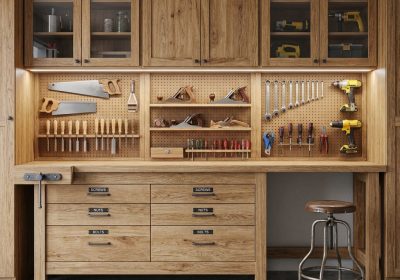
A garage workbench cabinet is the most forgiving of all cabinet builds. No one expects it to look like furniture — it just needs to be sturdy, well-organised, and long-lasting. This is an ideal first cabinet build because mistakes are invisible once the doors are closed, and the material cost is low when using structural ply.
Key dimension: Depth. 600mm is the standard workshop cabinet depth (compared to 580mm for bedroom wardrobes and 600mm for kitchen base cabinets). The extra depth accommodates large power tools and full-sheet sandpaper. Go shallower and you will be constantly frustrated.
Material recommendation: 18mm structural plywood throughout, including doors. No edge banding needed for a workshop. Seal the timber with one coat of satin polyurethane or even a water-based paint to prevent oil absorption.
Beginner tip: Build full-extension drawer slides into at least one section of the cabinet — a drawer that extends fully lets you see and access everything in it. Shallow fixed shelves hide items behind other items and become a mess within weeks.
Bathroom Vanity Cabinet
The bathroom environment is the most demanding for cabinet materials. Moisture from showers and baths, temperature swings, and direct contact with wet items all contribute to cabinet deterioration. The material choice is more important here than in any other room.
Key dimension: Bench height. Australian standard vanity height is 850–870mm to the top of the carcass. Add a 20–30mm stone or timber bench top for a finished height of 870–900mm. This is slightly higher than a kitchen bench, which is appropriate because you stand directly in front of a vanity basin rather than working at an angle.
Material recommendation: MR (moisture-resistant) MDF for painted cabinets, or 18mm structural ply with full sealing of all surfaces including the inside of the cabinet. Seal every cut edge with two coats of oil-based primer before assembly.
Beginner tip: Size the door openings generously. Under-sink plumbing — P-traps, isolation valves, flexible hoses — takes up significant space and you will need access to it. Leave at least one fully-opening door (not bifold) under the basin so a plumber can access the pipes without removing the cabinet.
Garden Storage Cabinet (Outdoor)
An outdoor garden cabinet stores tools, hoses, fertiliser, and potting mix — heavy, dirty items that would ruin any indoor furniture material. The key challenge is weatherproofing: the cabinet must shed water, resist UV, and remain structurally sound through an Australian summer (40-degree heat) and wet season.
Key dimension: Sill height. Mount the cabinet or set it on legs that hold the base at least 100mm off the ground. This prevents the base from sitting in pooled water and eliminates the moisture wicking that destroys untreated timber bases.
Material recommendation: Treated pine (H3 or H4 rated for outdoor use) or a durable hardwood like spotted gum, blackbutt or ironbark. These species resist rot and insect damage without chemical treatment. Do not use standard DAR pine outdoors — it will be rotting within 2–3 years even with paint protection.
Beginner tip: Use stainless steel or galvanised screws and hardware throughout. Zinc-plated screws corrode in outdoor conditions, leaving rust stains down the cabinet face and eventually failing structurally. The cost difference between zinc and stainless is minimal at the quantities used in a single cabinet.
Start Building
The beauty of storage cabinet construction is that the fundamental techniques — square carcass, face frame, adjustable shelves, hung doors — apply to every single cabinet type listed here. Master one, and the rest follow naturally. Each room you tackle after the first one will be faster and more confident.
For detailed, room-specific plans with cut lists, hardware specs and step-by-step instructions across all these cabinet types, Ted’s Woodworking provides over 16,000 plans for every room in the home — one of the most comprehensive plan libraries available for home woodworkers of any skill level.